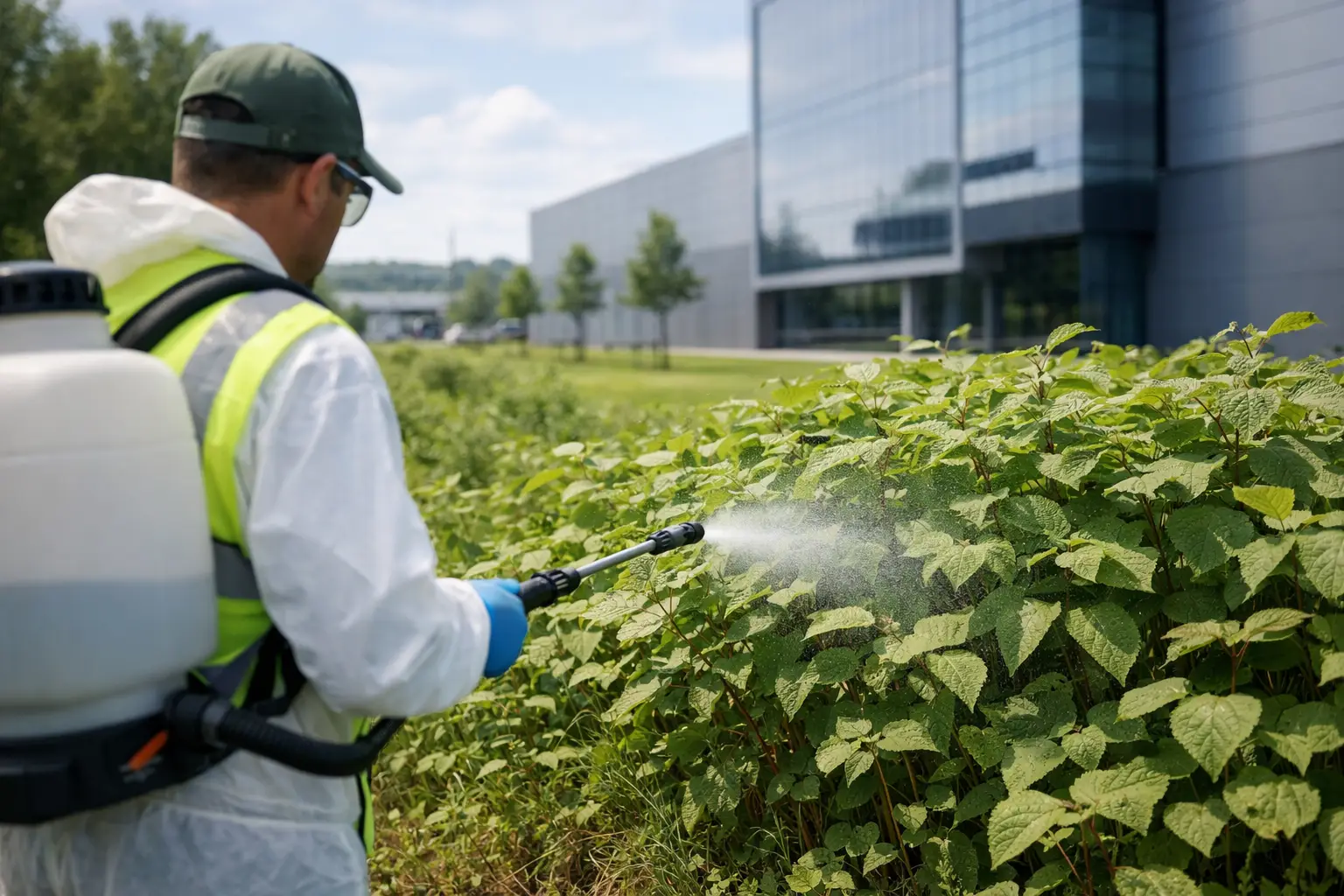
Commercial Knotweed Treatment Example

A retail park, depot, office block or managed industrial site does not get the luxury of ignoring Japanese knotweed for a season. A commercial knotweed treatment example shows why. What starts as visible growth on a boundary or behind a bin store can quickly turn into a compliance issue, a lease problem, a sale delay or a dispute with a neighbouring owner.
For commercial property, the question is rarely just whether knotweed is present. The real question is how quickly the issue can be documented, contained and managed in a way that protects the asset. That means formal survey work, clear evidence, measured site observations and a treatment plan that can be relied upon by owners, occupiers, lenders and solicitors.
A commercial knotweed treatment example in practice
Imagine a mixed-use commercial site in Surrey with office units at the front, service access to the rear and a shared boundary with light industrial land. A facilities manager notices dense seasonal growth near a fence line behind the car park. The site is not being redeveloped immediately, but a lease renewal and refinancing are due within months.
At this stage, guessing is expensive. If the plant is knotweed, delay can allow further spread and create a poor paper trail. If it is not knotweed, the owner still needs certainty. The first step is a professional site survey, not informal maintenance work.
A proper commercial survey records more than presence or absence. It should include measured observations, mapping of the affected area, photographs, notes on proximity to structures and boundaries, and commentary on likely impact to the wider site. On a commercial property, those details matter because risk does not sit neatly inside one planting bed. It affects access routes, future works, tenant concerns and potential liability beyond the red line of ownership.
Once the inspection is complete, the report becomes the foundation for decision-making. A fast turnaround is especially valuable in commercial settings where property managers and owners may need to update senior stakeholders quickly. A next-day report with photographs, site mapping and documented findings gives everyone the same evidence base and removes speculation.
What the survey needs to establish
In this example, the survey confirms Japanese knotweed along a 9-metre boundary run, with secondary growth extending into unmanaged ground near a service yard. It is not currently affecting the building slab, but it is within an area that contractors regularly access. The neighbouring land also shows signs of possible spread, which raises the importance of documenting the exact position and extent on the inspected site.
That distinction is crucial. Commercial owners need to know not only what is growing, but where responsibility begins and ends. A report should show observed growth in relation to fences, walls, hardstanding, outbuildings and adjacent land. If later questions arise during a transaction or dispute, good documentation is what protects the owner.
The survey also needs to identify whether excavation, herbicide treatment, monitoring or a combination of methods is appropriate. There is no single answer for every commercial site. A vacant development plot may justify a more aggressive approach than a fully operational business park where access, budget and disruption need careful control.
Building the treatment plan
Following the survey, the site moves into a structured treatment programme. In our commercial knotweed treatment example, excavation is not the first recommendation because the infestation is localised, the site is live, and immediate digging would interfere with operations and increase disposal costs. Instead, a phased herbicide-led management plan is recommended over five years, supported by regular monitoring and formal records.
This is often the right balance for commercial land that remains in use. It controls the infestation, demonstrates active management and creates a documented remediation history that can be shared when needed. It also avoids the false economy of ad hoc spraying by general maintenance teams, which may suppress visible growth briefly without addressing the underlying problem or producing defensible records.
The plan would normally set out the treatment area, timing of visits, expected seasonal pattern, monitoring points and conditions for reassessment. If growth appears beyond the mapped zone, the plan can be adjusted. That flexibility matters because knotweed management is rarely static. Weather, access restrictions and neighbouring activity can all affect progression.
For many owners, the value is not just in the treatment itself but in the framework around it. A five-year interest-free treatment plan gives predictable structure to a problem that otherwise feels open-ended. When paired with a 10-year insurance-backed guarantee, the site has a far clearer risk profile for lenders, buyers and professional advisers.
Why commercial sites need more than basic gardening work
Commercial knotweed is a property risk issue, not a grounds maintenance nuisance. That changes the standard required. If a site is being refinanced, sold or re-let, verbal reassurance is not enough. Decision-makers need written findings, images, measurements and a treatment schedule that shows proper control.
This is where many commercial owners lose time. They discover knotweed, ask a local contractor to spray it, and only later realise there is no formal report, no mapped evidence and no guarantee. When solicitors or surveyors ask for documentation, the owner has to start again. By then, a straightforward issue has become a transaction delay.
A specialist process prevents that. First identify the plant correctly. Then inspect the full risk area, including beds, boundaries and neighbouring fence lines. Then issue a detailed written report with photographic evidence and measured site observations. Only after that should treatment begin. The order matters because it creates a record that stands up under scrutiny.
Treatment options depend on the site
Not every commercial knotweed treatment example looks the same. A warehouse with open rear land may suit one approach. A school, care setting, flat block or office complex may require another. The right solution depends on infestation size, access, operational constraints, future development plans and the need for immediate assurance during a sale or refinance.
Herbicide-led treatment is often suitable where the infestation can be managed over time and where minimal disruption is a priority. Excavation and removal may be appropriate where redevelopment is imminent or where the affected ground must be cleared quickly for works. Both approaches need careful planning, and disposal must be handled properly if contaminated material is removed from site.
There are trade-offs. Excavation can produce faster physical removal but usually comes with higher short-term cost and more disruption. Herbicide treatment is generally less intrusive and more cost-effective over time, but it requires patience, monitoring and good records. The right answer depends on what the commercial property needs to achieve.
Why speed matters so much
When knotweed is identified on a commercial site, delay tends to multiply the problem. Lease events keep moving. Contractors still need access. Buyers and lenders still ask questions. If the owner cannot produce a clear report and treatment pathway quickly, the uncertainty itself becomes damaging.
That is why rapid surveying and next-day paperwork are so valuable. A fast, detailed report does not just confirm the issue. It gives the owner something practical to act on immediately. Internal teams can brief stakeholders, transactions can continue with proper disclosure, and treatment can be scheduled without losing control of the narrative.
For property managers and landlords, speed also reduces the chance of inconsistent communication. Once a formal report exists, everyone is working from the same information. That lowers the risk of mixed messages to tenants, buyers or neighbouring owners.
What a good outcome looks like
In our example, the owner proceeds with the recommended treatment plan. The infestation is mapped, monitored and treated across scheduled visits. The report and supporting evidence are retained for compliance and transaction purposes. When refinancing progresses, the owner can show that the problem was identified professionally, assessed properly and placed under formal management.
That is often the real goal. Not perfection by next week, but control. A commercial property does not need vague assurances. It needs a documented route from identification to resolution, with enough evidence to protect value and support informed decisions.
Japanese Knotweed Group Ltd works in exactly that space - turning a stressful discovery into a clear, structured process with survey evidence, fast reporting and longer-term treatment support.
If you suspect knotweed on commercial land, the most useful next step is not to wait for the next growing season or ask a general contractor for a quick opinion. It is to get the site inspected properly, get the paperwork in hand, and deal with the risk before it starts dictating your options.


Comments