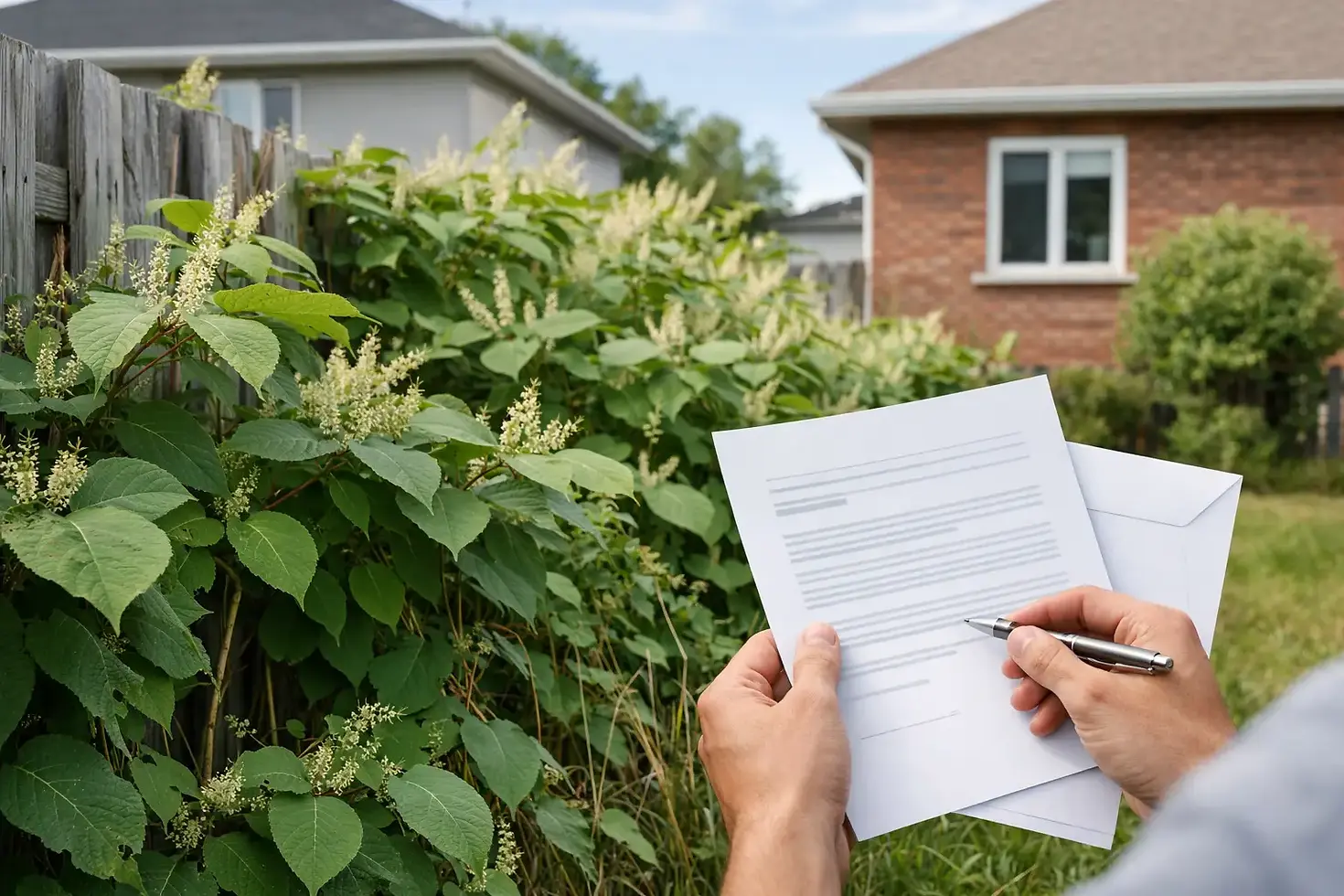
Knotweed Encroachment Letter Template for Neighbours

A boundary dispute can turn sour quickly when Japanese knotweed is involved. If you are looking for a knotweed encroachment letter template for neighbours, the aim is not to inflame the situation. It is to put your concern in writing, create a clear record, and give your neighbour a fair chance to act before the problem grows into a wider property issue.
That written record matters more than many owners realise. Japanese knotweed is not just an untidy garden nuisance. It can affect saleability, delay conveyancing, concern mortgage lenders, and create arguments over responsibility if growth crosses a boundary line. A calm, factual letter is often the right first step.
When a knotweed encroachment letter template for neighbours helps
A letter is useful when you have reasonable grounds to believe knotweed is present on or near the boundary and may be spreading from a neighbouring property onto yours. You might have seen canes, shield-shaped leaves, dense growth, or dead bamboo-like stems from the previous season. Equally, a surveyor may have flagged suspected knotweed during a purchase or valuation.
What a letter does is simple. It dates your concern, explains what you have observed, and asks for co-operation. That matters if the issue later affects a sale, a remortgage, repair costs, or a formal complaint. It also helps keep the tone measured. Conversations over the fence can become emotional. A short letter gives both sides something concrete to work from.
That said, a letter should not overstate the position. If you are not certain it is Japanese knotweed, say that it is suspected or appears to be knotweed. Misidentification does happen, and a confident accusation without evidence can make an avoidable situation harder.
Before you send anything
Take a moment to gather facts. Photograph the area from your side of the boundary if it is visible and lawful to do so. Make a note of dates, recent changes in growth, and any visible spread through beds, under fencing, or along outbuildings and hardstanding. If you are in the middle of a sale or purchase, keep copies of any survey comments or solicitor enquiries.
The strongest position is a professional survey. A proper inspection gives you more than opinion. It creates a documented report with photographs, mapped locations and measured observations around gardens, borders and fence lines. If the issue is affecting a transaction, speed matters. Formal paperwork is often what moves matters forward, not a debate about whether a plant is or is not knotweed.
There is also a practical point here. Some neighbours respond well to a polite letter. Others do not act until they understand that the concern has been professionally assessed and recorded. If you suspect encroachment, evidence usually gets results faster than argument.
What to include in your letter
Keep it calm, direct and specific. State your address and the neighbouring address, identify the area of concern, and explain why you believe Japanese knotweed may be present. If growth appears to be crossing the boundary, say so plainly. Ask the neighbour to investigate and confirm what action they intend to take.
Avoid legal threats unless you have taken advice and intend to follow through. In most cases, an aggressive opening letter is not the best route. You want co-operation, access for inspection if needed, and a treatment plan that deals with the problem properly. A short deadline for reply is reasonable, especially if a sale, mortgage or contractor work is affected.
If you already have a professional report, refer to it. If you do not, you can still state that you are seeking specialist advice. The key is to remain factual. Stick to what you have seen, what impact you are worried about, and what response you are asking for.
Knotweed encroachment letter template for neighbours
You can adapt the wording below to suit your situation.
Dear [Neighbour's Name],
I am writing regarding suspected Japanese knotweed growth at or near the boundary between [your address] and [neighbour's address]. I have recently observed plant growth in the area of [describe location - for example, rear garden boundary, side fence line, near garage wall], which appears to be Japanese knotweed and may be encroaching onto my property.
I wanted to raise this with you promptly and in writing so that the matter can be investigated before it becomes more serious. As you may know, Japanese knotweed can affect property value, create issues during sales and mortgage applications, and require specialist treatment and controlled disposal.
The growth I have observed includes [brief description - for example, tall red-green canes, dense clusters, broad shield-shaped leaves, previous dead stems]. I am concerned that the plant may already be spreading across or beneath the boundary line.
I would be grateful if you could arrange for the area to be inspected and let me know what steps you intend to take. If helpful, I am also arranging / I have arranged a specialist survey so that the position can be properly assessed.
Please respond within [7 or 14] days of the date of this letter so that we can deal with the matter promptly and avoid any unnecessary escalation.
I hope we can resolve this amicably and without delay.
Yours sincerely,
[Your Name] [Your Address] [Your Contact Details]
That template works because it is firm without becoming hostile. It flags risk, asks for action and leaves room for a sensible response.
Should you mention legal responsibility?
Sometimes yes, sometimes no. If knotweed is clearly spreading from one property into another and causing loss, legal responsibility can become relevant. But the first letter is rarely the place for a full legal argument unless solicitors are already involved.
A practical approach is usually better. Neighbours are more likely to respond to a letter that explains the property risk and asks for investigation than one that reads like a claim form. If they ignore you, deny access, or refuse to act despite clear evidence, that is the point at which more formal steps may be worth considering.
For owners, landlords and managing agents, the commercial reality is straightforward. Delay can make treatment more complex, documentation gaps can affect transactions, and informal promises carry little weight if the infestation resurfaces later.
Why professional evidence changes the conversation
A neighbour can dismiss a verbal complaint. It is much harder to dismiss a specialist report with photographs, mapped boundaries and measured site observations. That is especially true where the issue touches a sale, refinancing, insurance query or alleged property mis-selling.
This is where a specialist service becomes more than a plant identification exercise. A formal survey gives you a clear record of whether knotweed is present, where it is located, how close it is to structures or boundaries, and what should happen next. If treatment is required, a structured programme with documented follow-up and an insurance-backed guarantee gives both parties something concrete to rely on.
For many owners, that is the point where anxiety starts to lift. You move from suspicion and dispute to evidence and a plan.
If your neighbour ignores the letter
If there is no response, do not keep sending increasingly angry messages. Keep copies of what you have sent, note the lack of reply, and move to the next sensible step. That may mean instructing a specialist survey on your side of the boundary, asking a solicitor for advice, or notifying relevant parties if a sale is under way and disclosures are required.
It is also worth being realistic. If knotweed is established, it will not be solved by cutting it back, digging at it casually, or taking waste to a standard green waste site. Poor handling can spread the problem. Proper treatment and disposal matter, both for control and for the paperwork that may later be needed by buyers, lenders and surveyors.
In London and the surrounding counties, where property values and transaction pressures are high, delay tends to become expensive quickly. Fast inspection and next-day documentation can make a material difference when time is tight.
A letter is the start, not the solution
A well-written letter can open the door to a sensible conversation. It can also protect your position if that conversation does not go well. But the letter itself does not confirm the plant, measure the risk or remove the infestation.
If you are dealing with suspected encroachment, the strongest next step is usually a specialist survey followed by a clear treatment route if knotweed is confirmed. That is how you protect the property, reduce the chance of dispute and keep future sales from being dragged off course.
If you need certainty, act while the problem is still manageable. A calm letter helps. Proper evidence brings peace of mind.


Comments