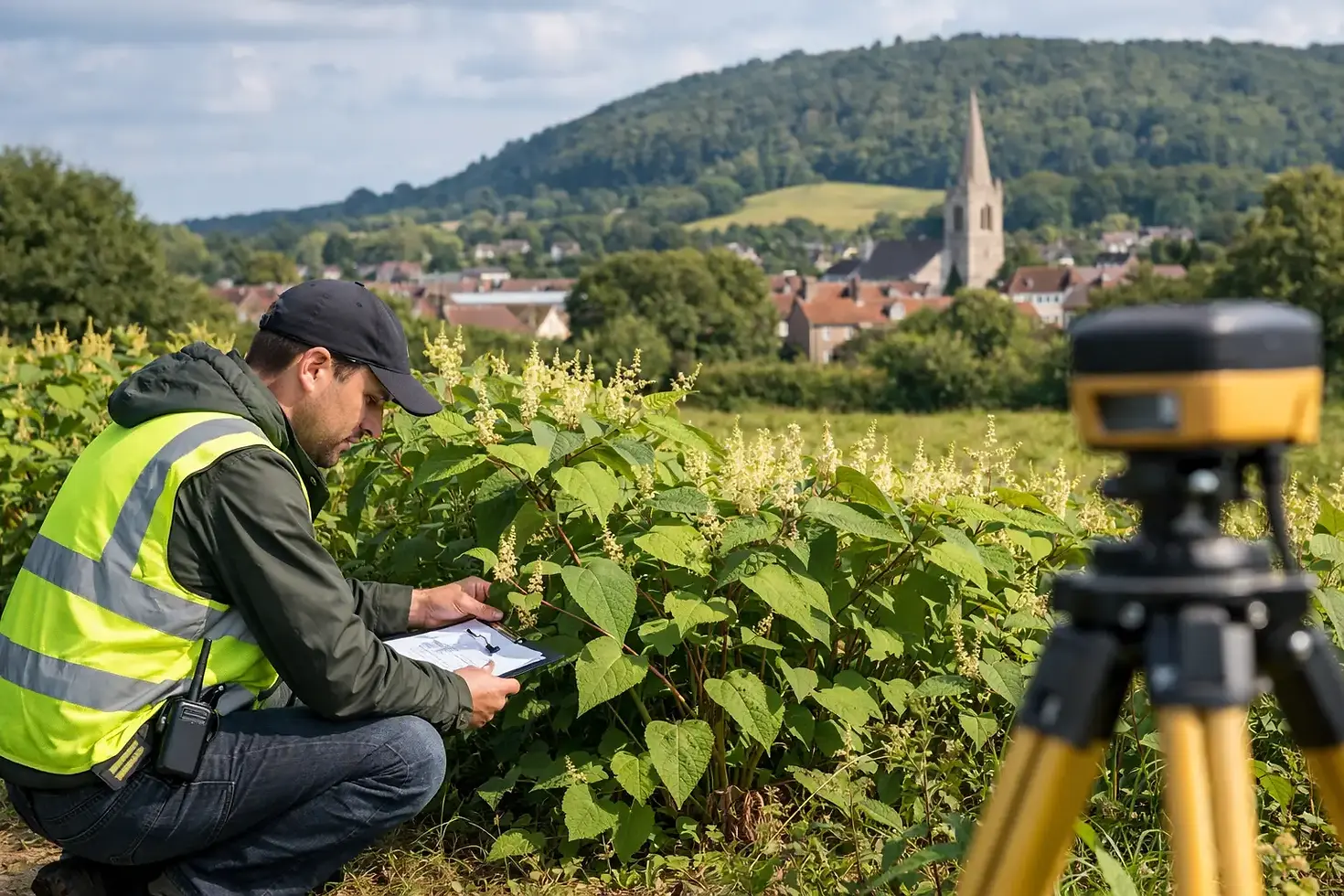
Japanese Knotweed Survey Dorking Guide

If you are buying, selling, managing or worrying about a property in Surrey, a Japanese knotweed survey Dorking owners can rely on is not a minor box-ticking exercise. It is the difference between clear evidence and costly uncertainty. When knotweed is suspected near a house, garden, outbuilding or boundary line, the priority is simple - confirm what is present, record it properly, and act before it affects value, lending or future works.
The problem with Japanese knotweed is not just the plant itself. It is what follows when nobody can prove where it is, how far it extends, whether it crosses a boundary, or what has already been done about it. Mortgage questions, buyer hesitation, neighbour disputes and delays in conveyancing often begin with poor information. A proper survey is designed to stop that spiral early.
Why a survey matters more than a quick opinion
Many property owners first notice knotweed when growth becomes obvious in spring and summer, or when a buyer, valuer or neighbour raises concern. At that point, online photos and informal opinions are not enough. Japanese knotweed is frequently confused with other species, especially when growth is young, cut back or mixed into dense planting.
A formal survey gives you a documented position. That matters whether knotweed is confirmed, ruled out, or found close to a boundary where future liability could become an issue. For sellers, it helps prevent last-minute disruption. For buyers, it provides a factual basis before exchange. For landlords, managing agents and commercial owners, it supports compliance, record-keeping and risk control.
This is why the survey stage should be treated as a professional property service rather than basic gardening advice. The goal is not simply to identify a weed. The goal is to establish evidence that stands up when decisions carry financial consequences.
What a Japanese knotweed survey in Dorking should cover
A useful survey does more than confirm the plant. It should inspect the full risk area and show exactly what has been seen on site. That usually includes gardens, beds, hardstanding edges, boundary lines and neighbouring fence lines where visible access allows. If the concern is near extensions, garages, retaining walls, drains or planned building works, those relationships need to be measured and recorded.
A structured report should include written findings, mapped observations, measurements and clear photographs. Without that level of detail, you are left with a vague opinion rather than something that can support a sale, purchase or treatment decision.
For many property owners, speed is just as important as accuracy. If a lender is waiting, a buyer is asking questions, or a transaction is already moving, delays in paperwork can become expensive. That is why next-day reporting can make a real difference. Fast reporting does not replace thoroughness. It removes the dead time that often adds stress to an already difficult situation.
What is included in a professional report
A proper Japanese knotweed survey Dorking homeowners and property professionals can use with confidence should be evidence-led. The strongest reports are practical documents, not generic notes.
At a minimum, you should expect a written assessment of the infestation or suspected infestation, measurements of affected areas where visible, site mapping and a clear photographic record. Extensive photographic evidence is particularly valuable because it shows the condition and location of growth at the time of inspection. A report supported by around 20 site images is far more useful than a one-line statement saying knotweed was seen somewhere near the rear garden.
The report should also describe where the plant sits in relation to boundaries and structures, because that is often the detail that matters most in transactions. A seller may need to show that the issue is being professionally managed. A buyer may need reassurance on extent and proximity. A property manager may need documentation to support the next stage of remediation and budgeting.
When to book a Japanese knotweed survey in Dorking
The right time to book is as soon as suspicion exists. Waiting rarely improves the position. If the plant is present, it can continue to spread and become harder to manage across growing seasons. If the plant is not present, a timely survey can prevent unnecessary fear, delays and bad decisions.
There are several common trigger points. The first is visual suspicion - fast-growing bamboo-like stems, shield-shaped leaves or previous die-back that has left dense cane material. The second is a property transaction, especially where a buyer, solicitor or lender wants formal confirmation. The third is a neighbour issue, where growth appears close to or across a shared boundary. The fourth is planned development. Any excavation, extension or landscaping work near suspected knotweed raises the stakes because disturbance can worsen spread and increase disposal obligations.
In all of these situations, the question is not whether to gather evidence. It is how quickly you can get reliable evidence in hand.
Survey findings are only the start
A survey is the decision point, not the finish line. Once knotweed is confirmed, the next step is a treatment plan that matches the site and the level of risk. That may be straightforward in some gardens and more involved on sites with tight access, neighbouring encroachment, previous failed treatment or construction plans.
What matters is that the survey feeds directly into a structured management approach. A five-year interest-free treatment plan gives property owners a defined route forward rather than a vague promise that the issue will be dealt with at some point. That kind of structure is especially important where buyers, lenders or managing agents need to see not only that knotweed has been identified, but that there is a formal programme in place.
Long-term reassurance also depends on what sits behind the treatment. A 10-year insurance-backed guarantee carries more weight than verbal assurances because it shows the work has been formalised around property risk, not casual maintenance. For owners trying to protect value or keep a sale moving, that distinction matters.
Why Dorking properties need a site-specific assessment
Dorking includes a broad mix of property types, from town-centre homes with compact gardens to larger edge-of-town plots and commercial land where vegetation can go unchecked for longer. That variety makes assumptions risky. Knotweed behaves differently depending on boundaries, access, previous landscaping, neighbouring land use and whether growth has been cut back, buried or disturbed in the past.
A site-specific survey helps separate visible growth from the wider risk picture. For example, a small above-ground patch may appear manageable, but the real issue could be its position near a fence line or close to areas where development is planned. On the other hand, an owner may fear the worst based on appearance alone and discover the plant is not knotweed at all. Both outcomes matter. The first prevents underestimating the problem. The second prevents unnecessary panic.
What to look for in a survey service
Not all surveys provide the same level of protection. If you need documentation for a property decision, look for a service built around evidence, turnaround and what happens next. A low-cost visual check with no proper report may seem attractive at first, but it often creates more work later when someone asks for photographs, mapping, measurements or a treatment proposal.
A stronger approach is one that starts with a defined survey product, typically from £199 plus VAT, and delivers a detailed written report, measured site observations, mapping and a substantial photographic record. It should also make clear how findings convert into treatment recommendations if knotweed is confirmed.
That is where specialist providers stand apart from general contractors. The issue is not simply identifying a plant. It is creating a documented pathway from suspicion to survey to treatment to guarantee, with paperwork that supports the realities of lending, conveyancing and asset protection.
Moving from uncertainty to control
When Japanese knotweed is suspected, hesitation is usually the most expensive response. Every day spent relying on guesswork leaves room for delay, dispute and avoidable anxiety. A formal survey replaces that uncertainty with measurements, images, mapped observations and a written record you can actually use.
For property owners in and around Dorking, the priority should be clear - get the site inspected, get the report back quickly, and if knotweed is confirmed, move straight into a managed treatment plan that protects both the property and the transaction around it. Japanese Knotweed Group Ltd is built around exactly that process, giving owners and buyers a practical route to peace of mind when the stakes are high.


Comments