Knotweed Survey vs Desktop Assessment

If a sale, remortgage or property query has put you face to face with the question of a knotweed survey vs desktop assessment, the difference matters more than most people expect. One gives you a remote view of possible risk. The other gives you site-specific evidence you can act on. When mortgage deadlines, boundary concerns and property value are involved, that gap is not a small technical detail.
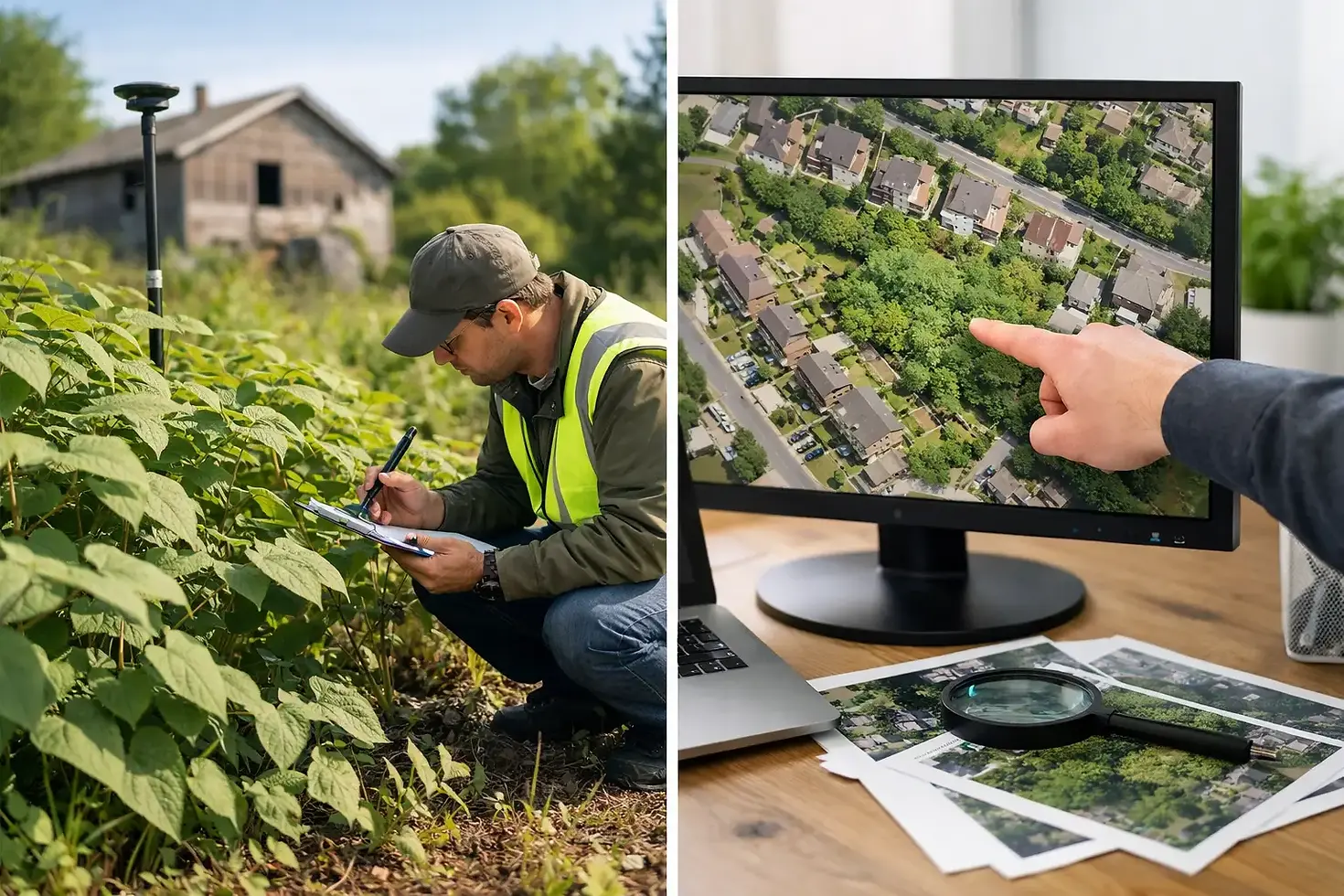
A desktop assessment can sound reassuring because it feels official. It may refer to mapping, historical records, nearby reports or environmental data to indicate whether Japanese knotweed could be an issue in the area. That has a place, particularly at an early screening stage. But it does not inspect your garden, your boundary line, the beds behind the shed, or the growth pushing through from next door.
A survey does. That is the key distinction.
What a desktop assessment actually does
A desktop assessment is a remote appraisal. It usually draws on existing information rather than physical inspection. In practice, that means it can flag the potential for Japanese knotweed risk based on location, prior records, aerial imagery or broader environmental datasets.
For some property professionals, that is useful as a first filter. If you manage a portfolio or want a quick sense of whether a site needs closer attention, a desktop review can help you decide what to do next. It can also be relevant where access is not yet available.
The limitation is straightforward. It cannot confirm what is physically present on the ground at the time of review. It cannot measure the extent of a stand, photograph the canes and crowns on site, assess likely spread along a fence line, or distinguish between knotweed and one of the plants it is often mistaken for. It can suggest risk. It cannot replace inspection.
Knotweed survey vs desktop assessment - the practical difference
The practical difference comes down to evidence.
A desktop assessment tells you what may be relevant to the property. A knotweed survey tells you what is actually there, where it is, how far it extends, and what needs to happen next. If you are buying, selling, dealing with a lender, or trying to avoid a dispute with a neighbour, that difference is usually decisive.
A formal on-site survey is designed to answer the questions that matter in real transactions. Is it Japanese knotweed? How extensive is it? Is it within the property boundary or likely to be encroaching from adjacent land? Has it affected areas close to structures, hardstanding or outbuildings? What treatment or removal route is appropriate? And what written evidence can be provided to support the next step?
Without that level of detail, people often end up in limbo. They know there may be an issue, but they do not have enough documented evidence to move forward with confidence.
When a desktop assessment may be enough
There are cases where a desktop assessment is a reasonable starting point. If you are at the very earliest stage of looking into a site, if access is delayed, or if a broad risk screen is all that is needed for internal decision-making, a remote review can save time.
It may also help where the concern is general rather than urgent. For example, a commercial property manager reviewing multiple sites may use desktop information to prioritise inspections. A landlord who has had a vague comment from a tenant about suspicious growth may use it as an initial check before commissioning fieldwork.
But even in those situations, the desktop assessment is only the first step if risk appears credible. It is not the endpoint where certainty is required.
When you need a knotweed survey instead
If there is visible plant growth, a lender query, a conveyancing delay, a neighbour complaint, or any concern about property value, an on-site survey is the safer choice. This is especially true when someone needs formal documentation, not just an opinion.
A proper survey gives measured observations across the areas where knotweed commonly creates problems - gardens, beds, boundary lines and neighbouring fence lines. It records what is found with photographic evidence and site mapping, then turns those findings into a written report that can be used in practical decision-making.
That matters because Japanese knotweed is rarely just a gardening issue. It becomes a property issue very quickly. Buyers want reassurance. Sellers need clear evidence. Lenders and solicitors want documentation that shows the issue has been identified properly and, where necessary, put into a structured treatment plan.
Why remote assessments often fall short in property transactions
Property transactions do not run on assumptions. They run on documentation.
If a desktop assessment suggests possible knotweed risk, the next question is almost always whether anyone has physically inspected the site. If the answer is no, the concern remains open. That can lead to delays, extra enquiries, reduced buyer confidence or pressure to commission a survey at short notice.
This is where many property owners lose time. They start with the cheaper or simpler option, then discover it does not answer the question their lender, solicitor or buyer is actually asking.
A site survey is more useful because it turns suspicion into evidence. It can confirm presence or absence, record the extent of visible growth, and support a treatment recommendation where needed. If no knotweed is found, that clarity is valuable in itself. If it is found, you are already in a position to act.
What to expect from a formal knotweed survey
A specialist survey should do more than identify a plant from a distance. It should document the site in a way that supports decision-making and reduces risk.
That means a written report, clear photography, mapping and measured observations. It should cover the obvious areas but also the places that are easy to miss, such as tucked-away beds, rear boundaries and neighbouring fence lines where encroachment may begin. The reporting needs to be clear enough for homeowners but formal enough for conveyancing and mortgage-related conversations.
At Japanese Knotweed Group Ltd, the survey product is built around that need for practical evidence. Starting from £199 plus VAT, it includes a detailed written report, 20 photographs, mapping and measured site observations, with next-day paperwork available. That speed can make a real difference when a transaction is already under pressure.
Knotweed survey vs desktop assessment - which saves money?
On paper, a desktop assessment may look like the cheaper route. Sometimes it is. But the better question is whether it avoids cost later.
If a desktop review leaves uncertainty, and uncertainty then triggers a delayed sale, further inspections or a dispute over disclosure, the initial saving can disappear quickly. By contrast, an on-site survey costs more upfront but can shorten the path to a clear answer. In property matters, speed and certainty often have financial value of their own.
It also depends on the risk profile of the site. A vacant plot at early feasibility stage may justify a different approach from an owner-occupied home with a buyer waiting. The right choice is not always the cheapest option. It is the option that fits the consequences of getting it wrong.
The link between survey evidence and treatment planning
A survey is not only about identifying a problem. It is the point where risk control starts.
Once knotweed is confirmed and mapped, a treatment plan can be structured around the actual extent of growth rather than guesswork. That matters for budgeting, timing and reassurance. It also matters for the formal record attached to the property.
For many owners, the real peace of mind comes from moving beyond diagnosis into managed resolution - a defined treatment programme, safe disposal where required, and a long-term guarantee that protects the property's marketability. A five-year interest-free treatment plan supported by a 10-year insurance-backed guarantee is far more persuasive than a vague note that knotweed might be nearby.
The right question is not which is better in theory
The right question is what you need the answer to do.
If you need an early-stage indication of local risk, a desktop assessment may be enough to point you in the right direction. If you need certainty, measured site observations and formal evidence that stands up in a property context, a survey is the stronger option.
For homeowners, buyers and property managers, that usually means the same thing. When the issue could affect value, lending or a sale, remote screening is helpful only until proper inspection becomes necessary. After that, delay tends to cost more than decisiveness.
If there is any real doubt about a plant on your land, or near your boundary, the calmest way forward is usually the direct one - get it inspected properly, get the findings in writing, and deal with the issue before it starts dictating the rest of your property decisions.


Comments