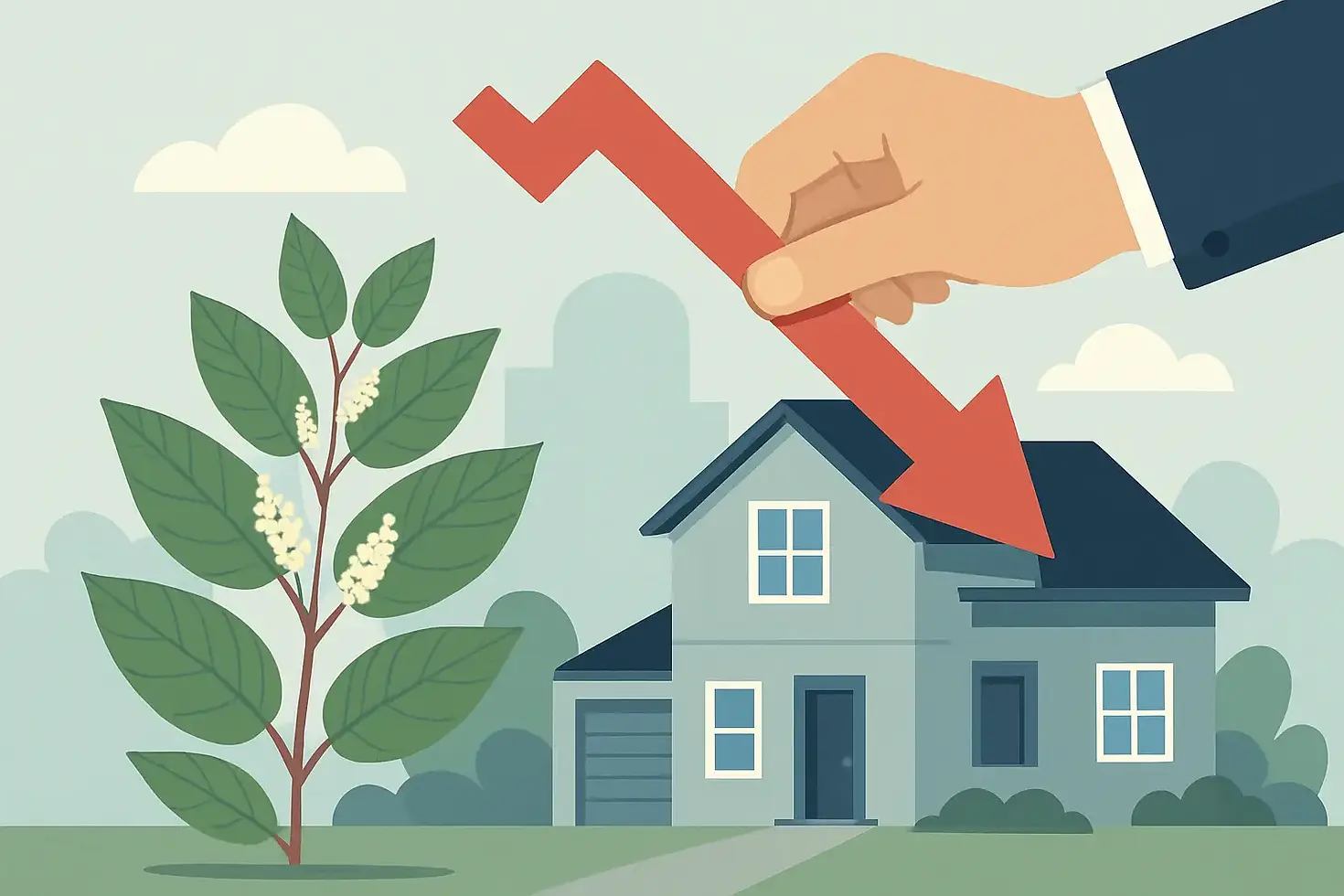
Does Japanese Knotweed Reduce Property Value?

The offer is on the table, the survey is booked, and then a photo lands in your inbox: a thick, bamboo-like stand near the fence line. Suddenly the conversation is not about kitchens or school catchments - it is about whether the buyer can even get a mortgage.
That is the real-world Japanese knotweed property value impact. It is rarely just a gardening issue. It becomes a transaction issue, a risk issue, and sometimes a legal headache. The good news is that it is also a manageable issue when you act quickly and document everything properly.
The real Japanese knotweed property value impact
Property value is not only what a valuer thinks a home is “worth”. In practice, value is what a buyer can pay, what a lender will lend, and how much uncertainty the buyer is willing to tolerate.
Japanese knotweed can affect value in three main ways. First, it can reduce demand. Many buyers will walk away the moment they hear the words, even if the plant is a small clump. Second, it can slow down or derail lending. Some lenders require specialist evidence and a treatment plan with a long-term guarantee before they will proceed. Third, it can weaken your negotiating position. If the buyer believes the risk is unknown, they will often price that fear into their offer.
None of this means every affected property is “unsellable”. It means uncertainty is expensive. Clear, mortgage-ready evidence tends to protect value more effectively than vague assurances.
Why knotweed affects mortgages and conveyancing
Knotweed triggers a different level of scrutiny because it is invasive, persistent, and can spread through fragments of rhizome. Even where there is no obvious structural damage, surveyors and lenders may view unmanaged growth as a future liability.
Conveyancers also take it seriously because disputes often come from what was said - or not said - during the sale. If knotweed is later discovered and a buyer feels it was concealed or downplayed, that is when accusations of misrepresentation can appear. The safest route is straightforward: identify it properly, map it, record it, and show how it is being managed.
When documentation is formal and consistent, it reduces the room for argument. It also helps a buyer feel they are purchasing a home, not inheriting a problem with no end date.
It depends: what actually drives the price impact
Two homes can both “have knotweed” and see very different outcomes. The difference is usually not the plant itself. It is the context.
Extent and location matter. Knotweed at the far end of a long garden is not the same as knotweed running along a shared boundary, or emerging near outbuildings, patios, retaining walls, or neighbouring structures. The closer it is to boundaries and built features, the more complicated discussions become, especially where neighbour cooperation may be needed.
Evidence matters just as much as biology. Buyers and lenders react better to measured site observations than to casual photos on a phone. Clear mapping, dated images, and notes on distances, height, density, and spread routes allow professionals to make decisions rather than assumptions.
Finally, management status matters. A property with unmanaged growth and no paperwork can feel like an open-ended risk. A property with a structured treatment plan, recorded progress, and a long-term guarantee is usually a very different proposition.
The most common scenarios we see in the South of England
Across London, Surrey, Kent, Essex, West Sussex and Hampshire, knotweed issues often appear at the worst possible moment - during a sale, refinance, or a planned extension.
Sometimes it is spotted by a buyer’s surveyor during a homebuyer report. Sometimes a neighbour raises it after seeing growth on a fence line. Sometimes a landlord discovers it when a tenant reports “strange bamboo”. And sometimes it appears after ground disturbance, such as landscaping or building work, when rhizomes are moved and regrowth accelerates.
What these scenarios have in common is urgency. Not panic - urgency. The faster you can get a formal identification and a documented plan, the more control you keep over the transaction.
What buyers and surveyors want to see
Most buyers are not looking for perfection. They are looking for confidence. That confidence usually comes from three things: proof of what is present, proof of what is being done, and proof that the solution is credible.
A proper on-site survey should do more than confirm “yes” or “no”. It should record the extent of growth, assess risk areas such as boundaries and structures, and include photographic evidence that stands up to scrutiny. Mapping is particularly helpful because it removes ambiguity about where the plant is and how it relates to the property line.
From there, the conversation becomes practical. How will it be treated? How long will it take? What happens if it returns? What paperwork will a lender accept? These are the questions that protect value because they replace fear with a plan.
Why a formal survey protects value better than informal opinions
A homeowner’s instinct is often to cut it back, dig it out, or spray it with an off-the-shelf herbicide. The problem is not the intention - it is the paper trail.
If you are selling, “We pulled it out last summer” usually does not help. It can even make things worse if it suggests the area was disturbed without proper disposal. Buyers and lenders want a clear, professional record that the site has been assessed properly and that treatment is structured and monitored.
A formal survey is also your best defence against false positives. Not every cane-like plant is knotweed. Misidentification can cause unnecessary alarm and knock confidence in the sale. A specialist survey gives you a definitive position, backed by photographs and measured observations.
What a mortgage-ready plan typically looks like
Mortgage and conveyancing processes favour clarity and long-term risk control. A credible plan usually includes monitored treatment over multiple growing seasons, with records of visits and progress.
It should also include an assurance mechanism that lasts beyond a single season. Buyers need to know they will not be left alone with regrowth after completion. This is why longer guarantees, particularly those that are insurance-backed, can be reassuring. They provide continuity if ownership changes, and they signal that the contractor is confident in the method and oversight.
Just as importantly, a plan should be tailored to the site. Treatment for knotweed along a boundary may need a different approach from knotweed in an open garden bed. A one-size-fits-all quote without a detailed site inspection is rarely helpful when you are trying to satisfy a lender.
Timing: when to act during a sale or purchase
If you are selling and knotweed is suspected, waiting for the buyer’s survey is rarely the best move. By then, the buyer is already primed to renegotiate or pause. Getting your own specialist survey early gives you control over the narrative and the paperwork.
If you are buying and knotweed is flagged, do not rely on verbal assurances that it is “being dealt with”. Ask for a specialist report, dated photographs, and details of any treatment plan and guarantee. If the knotweed is close to boundaries, you will also want clarity on whether neighbouring land is affected, because that can influence long-term management.
And if you are planning building work, deal with knotweed before you start. Disturbing contaminated ground can spread fragments and turn a contained issue into a wider one. Early identification is often cheaper than remediation after the fact.
The documentation that keeps transactions moving
When a sale is under pressure, paperwork speed matters. Next-day reporting can make the difference between “we can proceed” and “we have to wait”.
A transaction-ready pack typically includes a written report, clear photographs, mapping, and measured notes that show what was found and where. It should also state the recommended treatment approach and the management timeline, so the buyer and lender can understand the path to control.
If you need this level of certainty quickly, a specialist service like Japanese Knotweed Group Ltd focuses on rapid on-site surveys with detailed written reporting and photographic evidence, then converts findings into structured treatment supported by longer-term reassurance.
What not to do if you care about value
There are a few well-meaning actions that tend to create problems in sales.
First, do not assume cutting it back “solves” it. Visible canes are only part of the plant. The rhizome system is what drives regrowth. Second, be cautious about digging or moving soil. If contaminated material is spread around the garden or removed without proper handling, it can escalate cost and complicate future disclosure. Third, do not leave it undocumented. Even successful treatment can fail to protect value if you cannot prove what was done and when.
The aim is not to make your garden look tidy for viewings. The aim is to remove uncertainty for the people assessing risk.
A calmer way to think about the problem
Japanese knotweed is stressful because it feels personal - it is on your land, near your home, tied to your finances. But it is also a technical issue with established ways to assess and control it.
If you are facing a sale, purchase, refinance, or compliance question, treat knotweed like any other property risk: get it identified properly, get it measured and mapped, and get a plan that you can hand to a lender or solicitor without hesitation.
The most valuable shift is this: stop trying to “prove it is fine” and start producing evidence that it is being managed. Peace of mind follows good paperwork and a clear plan, and that is what keeps property decisions moving forward.


Comments