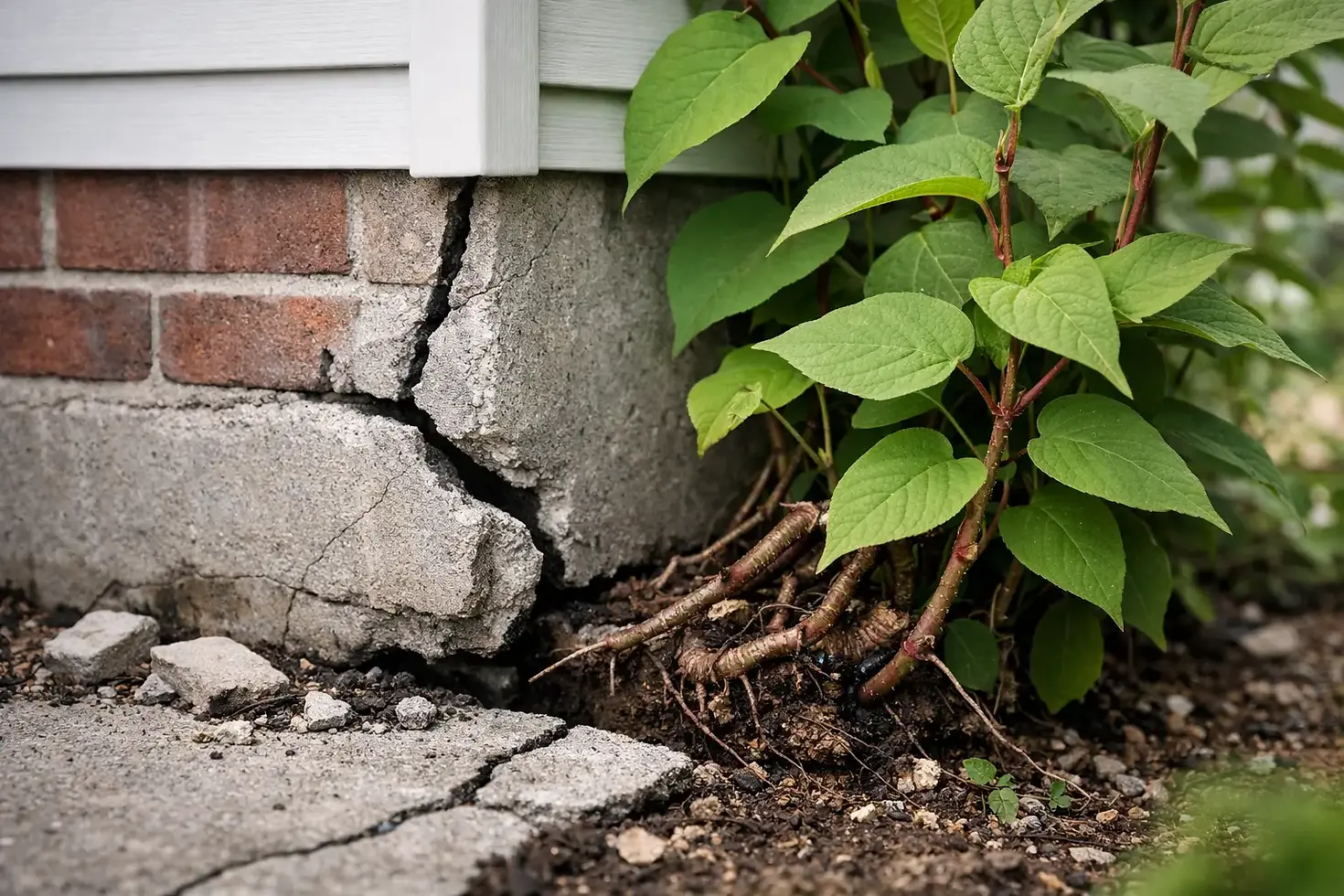
Does Japanese knotweed damage foundations?

You spot bamboo-like canes near the patio and the first thought is rarely botanical. It is financial. Will this affect the sale, the mortgage, the insurance, and in the worst case, the building itself?
So, does japanese knotweed damage foundations? The honest answer is: it can, but not in the cartoonish way people imagine. Japanese knotweed is not a magic drill that punches through solid concrete. What it can do, very effectively, is exploit existing weaknesses, push into poor-quality or already-compromised structures, and create the sort of risk profile that lenders and buyers do not tolerate.
Does japanese knotweed damage foundations - the real mechanism
Japanese knotweed spreads through rhizomes, which are underground stems. These rhizomes are persistent, capable of regrowth from small fragments, and they travel laterally through soil in search of space, moisture and light.
Where foundations and hard surfaces are intact and well-built, knotweed is more likely to be a nuisance than a bulldozer. The problem is that many properties in London and the surrounding counties have a mix of older footings, shallow foundations, historic repairs, poorly-laid paths, ageing retaining walls and service runs. Knotweed does not need to create a crack if a crack already exists. It will take the path of least resistance.
Think of knotweed less as “smashes through concrete” and more as “finds a weak point and makes it worse”. If a foundation wall already has a fissure, if a patio has a lifting corner, or if a drain has a failed joint, rhizomes can occupy that space. Over time, the plant’s growth cycle and moisture demand can contribute to movement and deterioration around those defects.
This is why the question is not just “is it knotweed?”, but “where is it, what is it interacting with, and what is the construction type and condition?”
When foundations are most at risk
Not every infestation carries the same structural concern. Risk rises when knotweed is close to buildings, where the ground is already compromised, or where there are “interfaces” between soil and manmade materials.
Older properties with shallow foundations can be more vulnerable to any aggressive vegetation simply because there is less depth and mass separating the structure from root zones and soil movement. Similarly, homes with extensions, garden rooms, conservatories and garages can have differing foundation depths and build quality across the same plot. Knotweed does not politely restrict itself to the “main house” area.
Ground conditions matter too. Made ground, loose fill, and areas that have been reworked for landscaping can provide easy routes for rhizomes. A neglected boundary line with brambles, ivy and debris often hides knotweed until it has already colonised the easiest corridors.
The final driver is proximity to defects. If knotweed is near existing cracks, failing pointing, gaps around service entries, or damaged drains, the likelihood of interaction increases. This is why a quick visual glance is rarely enough for peace of mind in a transaction.
What knotweed can affect besides foundations
Foundations are only one part of the problem. Many disputes and sale delays are triggered by damage - or potential damage - to adjacent structures and surfaces that are clearly visible.
Knotweed can undermine garden walls, distort paving, and creep into gaps around steps, patios and driveways. It can also interact with drainage runs and inspection chambers, particularly where joints are already compromised. Even where the building itself is sound, these issues can still create cost, disruption and a perception of risk.
From a buyer’s perspective, visible hardstanding damage reads as “the ground is moving” even if the underlying issue is a poorly-laid patio. From a lender’s perspective, the concern is control: is there a documented plan that reduces future risk and protects value?
Why distance alone is not a comfort blanket
You may hear broad statements about set distances. The reality is that distance is only meaningful when you combine it with measured site observations.
Rhizomes can spread laterally, but how far they have travelled on your site depends on history: how long the plant has been present, whether it has been cut back, whether soil has been moved, and whether growth has been “hidden” in boundaries or neighbouring land.
It is also common for knotweed to be present on an adjoining property and for rhizomes to extend under a fence line. If you only look at your side of the boundary, you may miss the wider picture that a buyer’s solicitor will later ask about.
This is where measured mapping and clear photographic evidence matter. It turns a stressful unknown into a defined risk that can be managed.
What a proper assessment should cover
If your goal is to protect a sale, avoid a mortgage issue, or simply sleep at night, you need more than a yes/no answer.
A credible assessment identifies the plant correctly (knotweed is frequently confused with other species), records where it is growing, and documents how it relates to structures. That means looking at gardens, beds, boundaries, neighbouring fence lines and any features that could provide access to voids or defects.
It also means recording what is there now, not what you hope is there. Buyers and lenders respond to documentation: dated photographs, site notes, and a clear plan. When those pieces are missing, the default assumption is higher risk.
Treatment versus removal - and why shortcuts backfire
When people panic about foundations, the temptation is to “dig it out” quickly. This is one of the most expensive mistakes property owners make.
Excavation can be appropriate, but only with proper controls: locating the rhizome mass, managing contaminated material, and disposing of it safely through authorised routes. Done badly, excavation spreads fragments, increases the affected area and can create a bigger problem for the next owner. It can also destabilise ground near structures if you remove soil without reinstatement designed for the site.
Herbicide-based treatment plans, when structured properly and carried out over the right timeframe, can be an effective and less disruptive route. The key is that it must be documented, monitored and continued long enough to deliver confidence, not just a temporary reduction in visible growth.
For property transactions, the “best” method is often the one that creates the clearest risk control pathway: a formal survey, a written plan, and an enforceable guarantee.
What buyers, solicitors and lenders actually want
Most transaction stress comes from uncertainty. When knotweed is suspected, the questions tend to be predictable.
Where is it? How extensive is it? Is it on neighbouring land? What is the management plan? Who is responsible? How long will it take? What guarantee is in place?
If you can answer those questions with measured evidence and a structured programme, the conversation changes. It becomes an agreed plan with a defined cost and timeline, rather than a frightening unknown.
This is also why “a gardener has been cutting it back” is not reassuring in a conveyancing context. Cutting can mask growth without reducing the rhizome network, and it removes the visual cues that would otherwise prompt early action.
The fastest way to reduce risk: survey first, then act
If you are worried about foundations, you do not need to guess. You need a formal baseline.
A professional knotweed survey should give you clear identification, mapped locations, measured observations and enough photographic evidence to stand up to scrutiny later. It should also translate findings into a treatment recommendation that fits your scenario: selling soon, buying, managing a rental, or protecting a commercial site.
At Japanese Knotweed Group Ltd, the survey product is designed for exactly this situation: a defined on-site survey (£250+VAT) with a detailed written report, mapping, measured observations and extensive photographic evidence, with next-day paperwork available for urgent transactions. Where treatment is needed, findings can be converted into a longer-term management route with a 5-year interest-free treatment plan and a 10-year insurance-backed guarantee. You can see the service outline at https://www.knotweedgroup.co.uk.
Practical signs that warrant immediate attention
You do not need to wait for damage to start taking the situation seriously.
If you see rapid spring growth with hollow, jointed stems, shovel-shaped leaves, and dense stands near hard surfaces or boundaries, act quickly. The same applies if you notice repeated regrowth after cutting, or if an area of the garden has become strangely “unkillable” despite routine maintenance.
Also treat any suspicion near drains, manholes, retaining walls, patios and extensions as time-sensitive. Even if the main house foundations are unaffected, these features often reveal the first interactions between rhizomes and structures.
A calm way to think about foundations
Worrying about foundations is rational, but it helps to frame the risk correctly.
Japanese knotweed is best understood as an amplifier of existing problems. If the ground and structures are well-built and in good condition, the plant is less likely to cause direct structural harm. If there are weaknesses, voids, or marginal construction, it can exploit them and make remediation more complex.
Either way, the decisive step is the same: get it identified properly, get it documented properly, and put a plan in place that you would be happy to show to a buyer, a lender, or a future version of yourself.
A property does not have to be perfect to be protected - it just needs a clear, evidenced route to control.


Comments