Bamboo Removal Without Property Damage

A few bamboo canes at the back of a border can look harmless. Then the shoots start appearing through lawns, under fences and in places you never planted them. Bamboo removal becomes far more than a gardening job when roots spread into neighbouring land, disturb hard landscaping or create a dispute during a sale.
For property owners, the main risk is not just fast growth. It is hidden spread. Running bamboo can travel well beyond the visible clump, sending rhizomes under patios, paths, sheds and boundary lines. If you only cut back what you can see, the problem often returns. The right approach depends on the species, the extent of the rhizome network and how close it is to structures.
Why bamboo becomes a property problem
Not all bamboo behaves in the same way. Clumping varieties expand slowly and usually stay close to where they were planted. Running bamboo is different. It spreads through underground rhizomes that can move laterally and emerge several metres away from the original plant.
That matters because the visible canes are only part of the issue. The real footprint may extend under fences, garden beds, retaining edges and neighbouring plots. In practical terms, that can mean recurring regrowth, damage to landscaping and increasing friction with adjoining owners.
Bamboo is not the same as Japanese knotweed from a legal or lending perspective, but it can still affect the enjoyment, use and management of land. A buyer who spots invasive growth near a boundary may ask questions. A landlord may need to act quickly to prevent tenant complaints. A commercial site manager may need a documented plan for control and disposal. In each case, delay tends to make the work more disruptive and more expensive.
What proper bamboo removal actually involves
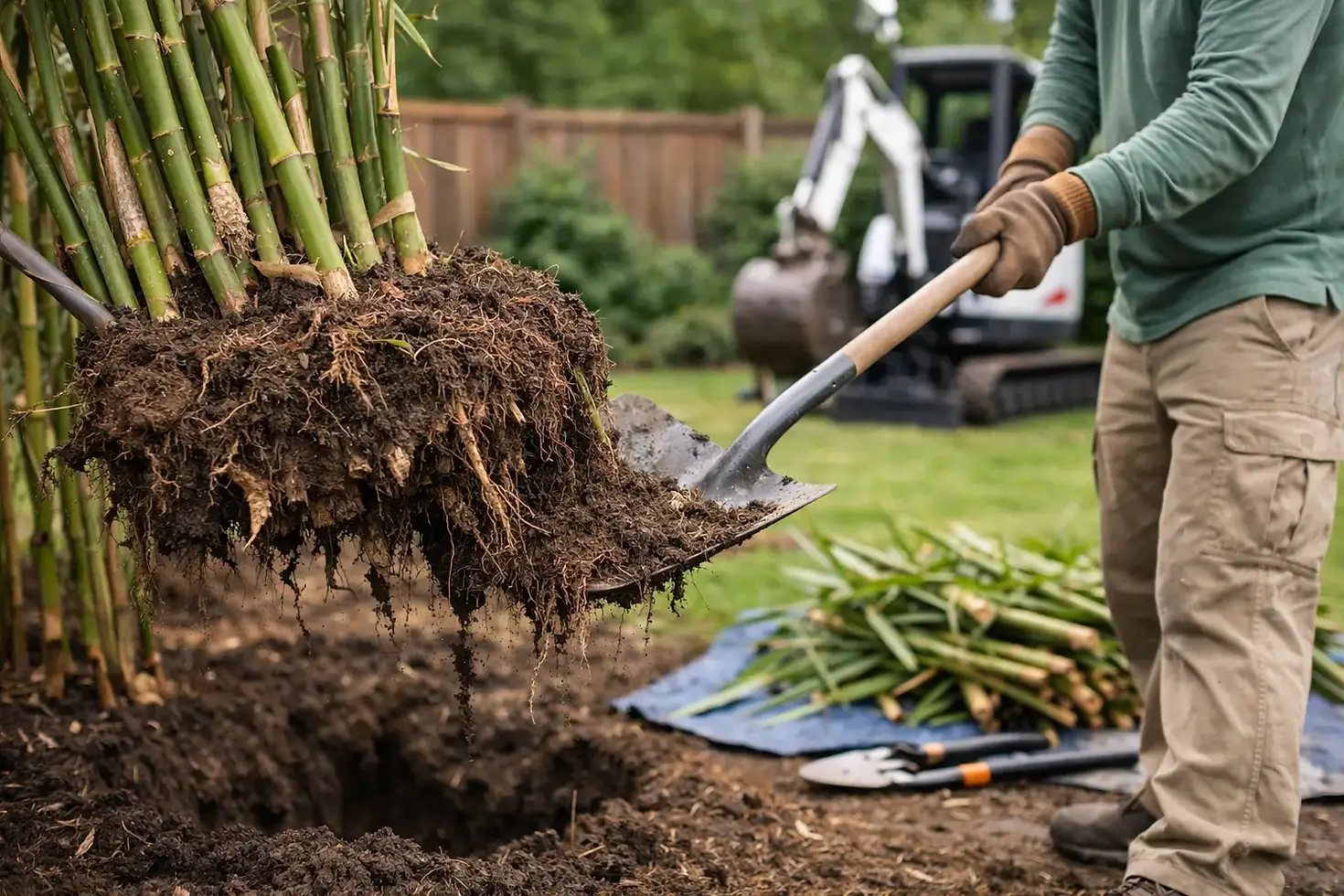
Effective bamboo removal means dealing with the rhizome system, not simply cutting down the canes. If the underground network remains active, new shoots are likely to appear in the next growing season, and often sooner.
The first step is identifying what kind of bamboo is present and mapping the spread. That sounds basic, but it changes the whole method. A tight clump in an open bed can often be managed with excavation. A running bamboo stand that has crossed a boundary or entered established landscaping needs a more careful plan.
A proper assessment should consider the visible growth, likely rhizome direction, nearby structures, access constraints and whether disposal will require controlled handling. Where rhizomes are close to walls, paving, drains or neighbouring land, guessing is risky. Partial excavation can leave viable sections behind and make future tracking harder.
Signs your bamboo has spread further than you think
In many gardens, the first warning sign is a new shoot appearing away from the parent plant. That might be in the lawn, in a raised bed, beside a path or under a fence line. Another common sign is repeated regrowth after cutting back.
You may also notice paving lifting slightly, edging being pushed out of line or dense, fibrous roots appearing when digging in nearby soil. Where bamboo has been in place for years, especially without root barriers, the underground spread can be substantial even if the top growth looks manageable.
This is where property owners often lose time. They tackle the visible growth, assume the issue is under control and then face another flush of shoots months later. By that stage, the rhizomes may have extended into harder-to-reach areas.
Can you remove bamboo yourself?
Sometimes, yes. Small clumping bamboo in a clear, accessible bed may be suitable for DIY removal if you are prepared for heavy digging and careful follow-up. You need to remove the root mass thoroughly and monitor the area for regrowth.
Running bamboo is where DIY efforts often fall short. The work is labour-intensive, but the bigger challenge is completeness. Rhizomes can sit deep enough to be missed and long enough to continue beyond the area you planned to excavate. If the spread runs near outbuildings, paved areas, retaining features or boundary lines, the risk of incomplete removal rises sharply.
There is also the issue of disposal. Simply moving dug-out rhizomes to another part of the garden is asking for the problem to continue. Even small sections can remain viable. If you are dealing with substantial volumes, you need a sensible disposal plan that prevents re-establishment.
DIY can save money on very limited growth. It can also create a false economy if the infestation returns, or if missed rhizomes spread into neighbouring land. Where property value, saleability or a live dispute is involved, a documented professional approach is usually the safer decision.
Bamboo removal methods and when they work
Excavation is the most direct method. It involves cutting back top growth, exposing the rhizome network and removing as much of it as possible from the affected area. This is often the fastest route to physical clearance, especially where a site needs to be brought under control before landscaping or sale.
However, excavation has trade-offs. It can be disruptive, access-dependent and more involved where bamboo has grown through established planting schemes or hard surfaces. If rhizomes have crossed under fences or walls, the full extent may not be recoverable from one side alone.
Repeated cutting and depletion can help in some cases, but it takes persistence. New shoots must be cut down consistently to exhaust the plant's reserves. This approach is slower, less certain and rarely the right answer for owners who need a clear timetable.
Chemical treatment may be considered as part of a management strategy, but results vary and it is usually not a quick fix. Dense stands, mature rhizomes and mixed site conditions can limit effectiveness. For many property owners, especially those needing confidence around boundaries and long-term control, a structured removal and monitoring plan makes more sense than relying on ad hoc treatment.
Why boundaries make bamboo removal more serious
Once bamboo crosses a boundary, it stops being a private gardening issue. It becomes a matter of neighbouring land use, responsibility and evidence. If shoots are appearing next door, informal promises to "keep an eye on it" are rarely enough.
This is where clear site records matter. Measuring affected areas, photographing visible growth and recording the relationship to fences, beds and adjoining land can help establish what is happening and what action is being taken. For owners involved in a sale, a boundary issue with invasive growth can raise awkward questions if it has not been addressed properly.
A professional survey is often the quickest way to replace uncertainty with facts. At that stage, the goal is not just identifying bamboo. It is understanding the footprint, the likely risk to neighbouring areas and the most appropriate treatment route.
When a survey is the sensible first step
If the bamboo is close to a house, retaining wall, paved area or shared boundary, a survey is usually worth arranging before removal starts. The same applies if you are buying or selling a property and need confidence that the problem has been assessed properly.
A formal survey gives you more than a visual opinion. It should provide measured site observations, mapped affected areas, photographic evidence and a written assessment that can support next steps. For buyers and sellers, that level of documentation is far more useful than a verbal assurance from a contractor with a spade.
This is particularly relevant in London and the surrounding counties, where boundary lines are often tight, gardens are compact and property transactions move under scrutiny. A rushed removal attempt can leave unanswered questions. A documented plan gives owners, buyers and professionals something solid to work from.
What a professional bamboo removal plan should include
The best removal plans are clear, evidence-led and realistic about timeframes. They should set out the area affected, the likely extent of rhizome spread, the recommended method of control or excavation and how waste will be handled safely.
Just as importantly, they should explain what happens after the initial work. Bamboo regrowth is not always immediate, and sites often need monitoring. Where excavation is partial because of access limits or adjacent structures, follow-up inspections become even more important.
For higher-stakes property situations, documentation matters almost as much as the work itself. A written report, site photos, mapped observations and a structured treatment programme create reassurance for owners and useful evidence for buyers, surveyors and managing agents. This is the kind of process Japanese Knotweed Group Ltd applies when dealing with invasive plant risk more broadly - not guesswork, but formal assessment followed by a clear route to control.
The cost of waiting
Bamboo rarely becomes easier to remove by being ignored. Rhizomes continue to spread, top growth thickens and access can worsen as the plant establishes around fences, sheds, decking and planted borders. What begins as an isolated patch can become a wider excavation job with more reinstatement needed afterwards.
There is also the human cost. Ongoing regrowth is frustrating. Boundary tension is stressful. Property sales can slow when vegetation issues appear unmanaged. Acting early gives you more options and usually causes less disruption overall.
If you suspect the bamboo on your land is spreading beyond where it was planted, the most useful next step is a proper assessment. Once you know the extent, you can decide whether simple excavation will solve it or whether you need a more structured removal plan to protect the property and move forward with confidence.


Comments